

What are the things you least want to read but most need to hear?
Questions have poured in from around the globe for this week’s #LentChallenge reading. Download a free guide here.
People are wondering:
Who is the son of man? What’s with all the demons?
Each week during the #LentChallenge, we’re collecting YOUR questions to send to our oh-so-brilliant New Testament scholar and professor, Dr. Craig Blomberg.
Soak up his wisdom and insight today.
(Stumped by a passage or verse as you’re reading? Leave your question for Dr. Blomberg as a comment to this blog post).
Jesus silences the demons he is casting out because they knew him. Why? What is the purpose of this? (Mark 1:25, 34)
Knowing a person, and especially their name, was a key to gaining spiritual mastery over them. The demons are not just showing their supernatural knowledge; they are trying to gain mastery over Jesus and ward him off. But they are unsuccessful and Jesus shows he has the spiritual power by exorcising them instead.
What’s the difference between the Son of Man and the Son of God?
The Son of Man was a name in the Old Testament that first of all referred to a person’s humanity, but could be used to contrast the difference between them and God. God frequently addresses Ezekiel as “son of man” in ways that make it clear it means “mere mortal.” But Daniel 7:13 describes one like a son of man coming on the clouds of heaven and being ushered into the very presence of the Ancient of Days, a title for God, and being given eternal dominion over the kingdoms of the earth. This human is also an exalted, supernatural, Messianic figure.
Jesus’ use of Son of Man, at least most of the time and perhaps all of the time draws on this background. Son of God in Old Testament and intertestamental Judaism could mean a follower of God, an exalted human being, an angel or the Messiah. In the first-century Greco-Roman world it was often used for humans who were believed to have been deified upon their deaths. We need to recognize a range of usages in the New Testament, therefore. When the Roman centurion used it of Jesus after he died, he may have thought of him like a noble philosopher or deceased emperor, now turned into a god.
When Jesus uses it, especially in John’s Gospel, of the uniquely intimate relationship he has with his heavenly Father, it reflects his divinity even while incarnate as a human being.
Matthew 12:43-45 is extra confusing. Can you help shed some light on this passage? What is with the seven impure spirits?
Ancient Jewish believe often associated demons with large bodies of water. The high seas were, after all, far more terrifying in those days without the kinds of seagoing vessels we have today. The Greek in this passage literally refers to the exorcised demon as passing through waterless places. Because he doesn’t find any, he doesn’t get the rest he seeks. Because the man has not replaced the evil spirit with anything good, he is ripe for being re-possessed and wind up worse off than he was before.
Seven is always the number of completion for Jews, so this is complete horror, complete re-possession by the demonic. The point, though, is actually quite simple. It’s not enough to remove the bad from one’s life without replacing it with something good.
It’s not enough to kick Satan out without replacing him with Jesus.
In Matthew 13:50, Jesus uses the imagery of “gnashing of teeth”? This sounds terrible. What is it? And how do I avoid it?
You avoid it by not going to hell! “Weeping and gnashing of teeth” appears several times in Scripture as one of the many metaphorical ways of depicting the eternal horror of being separated from God and all things good. And the way to avoid going to hell is to trust in Jesus as Lord and Savior and persevere in discipleship and following him throughout your entire life.
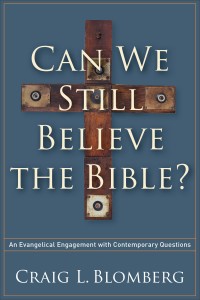 Want to learn more? Pick up a copy of Craig Blomberg‘s brand new book, Can We Still Believe the Bible? An Evangelical Engagement with Contemporary Questions.
Dr . Craig L. Blomberg (PhD, University of Aberdeen) is distinguished professor of New Testament at Denver Seminary, where he has taught for more than twenty-five years. He is the author or editor of numerous books, including A Handbook of New Testament Exegesis, Jesus and the Gospels, The Historical Reliability of the Gospels, Preaching the Parables, Making Sense of the New Testament, and commentaries on Matthew, 1 Corinthians, and James.
Challenges to the reliability of Scripture are perennial and have frequently been addressed. However, some of these challenges are noticeably more common today, and the topic is currently of particular interest among evangelicals. In this book, biblical scholar Craig Blomberg offers answers to questions like:
Aren’t the Copies of the Bible Hopelessly Corrupt?
Can We Trust Any of Our Translations of the Bible?
Don’t All the Miracles Make the Bible Mythical?
What verse has you stumped?
Have you ran into a passage that’s tricky to interpret? What’s a question about the Bible, theology, or Christianity that has been lingering in your head? Leave your questions as comments below.


How do you resolve the difference between the vengeful God of the OT with the loving and forgiving God of the NT as spoken of by Jesus? In the OT, God killed or caused to be killed many innocent people as well as animals. How can I believe He changed into the God of the NT? My mother was Catholic so I was raised with the idea of that OT God back in the 50’s & 60’s and constantly threatened with what God would do to me if I wasn’t good or thankful. It is hard to get past those fears. I’ve never known a merciful, forgiving, loving God.
Thanks for your comment!
Matt 22:14 ” Many are invited but few are chosen”. What does this mean…few are chosen?
In Luke 11:51, Jesus refers to a specific murder of a prophet, Zechariah “who perished between the altar and the house of God…” Was Jesus calling out a dirty secret that only the Pharisees/other religious leaders would have known about? Was He proving His omniscience to them? Or, was Jesus acting similarly to John the Baptist did when John called out Herod’s sin in his marriage relationship?
Why does Jesus ends some parables with “Do no tell” and other parables with “Go tell”?
Such a great question, Leandra. We have Dr. Blomberg weighing in on it this week!
Dr. Blomberg will be answering your question on Friday, Kathy!
Hi Christine! Great question– Dr. Blomberg weighed in on this, here: http://wp.me/p2Hg0R-7TU
Question- Where in the Bible does it say if Jesus Christ has a soul? Did he or not?
Were the people in Sodom and Gomorrah Jewish ?
Gentiles must be reborn unto Christ to be saved . Is it the same with Jewish people ?
After God destroyed the tower of Babel and scattered the people, did God intend for the confusion of the language of the people to be forever?
If you do not have a good answer for this question can you refer me to someone who can provide an answer?
Frank-Andrew.
I am having a texting discussion with a friend who is filled with doubt and I don’t know how to answer this question. Here is her text to me: “If God can do anything and God loves us, why does he cause pain. God talks about how to treat slaves when he could and should say slavery is wrong. During Passover he killed first-born males? He has smited whole civilizations in the old Testament?”So, how can you say he is a loving Father. Would you do this to your children no matter how wrong they have been?
Revelation 2:28
What is meant by I will give him the morning star? What is the morning star ? Its not himself but what ?
How many bible canons are in use today in the world?
What’s your interpretation of the original Aramaic John 16:24?: Ask without hidden motive and be surrounded by your answer,
Be enveloped by what you desire.
Acanaanitian = Akhenaten?
In the Greek there are at least 3 words used for sin. The Greek word used for all mankind means, missing the mark,, less than perfect.
So is the claim that all men are born depraved false? What types of sin falls into the category of depraved?
How would one respond to the statement that the God of the Muslims is the same God as the God of the Christian faith? I am aware that Abraham had Ishmael, his firstborn son, who was the predecessor of the Islamic religion and Isaac, to whom God gave his covenant and is the predecessor of the Christian faith. Would you consider the God of both faiths to be the same God?
Other than in 1 Corinthians 7:2-5, is there anywhere in the Bible that authorizes a wife to withhold physical love from her husband?
I apologise for the crazy long question, but I need a greek scholar for this question. I am studying the new testament greek verb for conviction (ελεγχωm) and I found several online definitions that included to “cross-examine”. None of the bible dictionaries or commentaries that I looked at had this as part of the definition of this word. Because people don’t bother to cite sources, it took me awhile, but I believe the source of this is probably Vincent’s Word Studies. In his commentary on John 3:20, he says of this word:
In earlier classical Greek it signifies to disgrace or put to shame. Thus Ulysses, having succeeded in the trial of the bow, says to Telemachus, “the stranger who sits in thy halls disgraces [ελεγχει] thee not” (” Odyssey, 21 424). Then, to cross – examine or question, for the purpose of convincing, convicting, or refuting; to censure, accuse. So Herodotus : “In his reply Alexander became confused, and diverged from the truth, whereon the slaves interposed, confuted his statements (hlegcon, cross – questioned and caught him in falsehood), and told the whole history of the crime” (i. 115).
I have a year of New Testament Greek (that I haven’t really kept up with), so I’m very much a novice, and I know nothing about other (non NT) ancient Greek texts. The English translation of Herodotus that Vincent quotes, “the slaves interposed, confuted his statement”, does not at all (to me) sound like cross-examination. It sounds more like they jumped up and yelled, “He’s lying!” Is there something in the context that I’m missing?
I also found two other sources that use the same passage from Herodotus to show that this word can mean cross-examine.
Liddell-Scott-Jones Definitions
–
ἐλέγχω,
Od. 21.424, etc.: fut. ἐλέγξω Ar. Nu. 1043, etc.: aor. ἤλεγξα Il. 9.522, etc.: — Pass., fut. ἐλεγχθήσομαι Antipho 2.4.10, X. Mem. 1.7.2: aor. ἠλέγχθην Antipho l.c., Pl. Grg. 458a, etc.: pf. ἐλήλεγμαι Id. Lg. 805c: 3 sg. ἐλήλεγκται Antiphol.c. (ἐξ-ηλεγμένοι is f.l. in Lys. 6.44): plpf. ἐξ-ελήλεγκτο D. 32.27: —
I disgrace, put to shame, μῦθον ἐ. treat a speech with contempt, Il. 9.522; ἐ. τινά put one to shame, Od. 21.424. — This usage is only
II
1. cross-examine, question, Hdt. 2.115, Pl. Revelation 18:1-24 d, etc.; μὴ ‘λεγχε τὸν πονοῦντα A. Ch. 919; φύλαξ ἐλέγχων φύλακα S. Ant. 260; τί ταῦτ’ ἄλλως ἐλέγχεις; Id. OT 333, cf. 783; ἔλεγχ’, ἐλέγχου Ar. Ra. 857; ἐ. τινὰ περί τινος Id. Pl. 574; ἕνεκά τινος Antiph. 207.10; τὰς ἀρχὰς βασάνοις χρώμενοι ἐλεγχόντων Pl. Lg. 946c: c. acc. et inf., accuse one of doing, E. Alc. 1058: — Pass., to be convicted, Hdt. 1.24, 117; ἐλεγχόμενοι εἴ τι περιγένοιτο τῶν χρημάτων D. 35.36, cf. Pl. Prt. 331c, 331d: with part., ἐλεγχθεὶς διαφθείρας Antipho 2.3.9, cf. 2.4.10; ἐλεγχθήσεται γελοῖος ὤν X. Mem. 1.7.2.
I understand very little of the above except that supposedly Hdt. 2.115 (which I assume is the same passage) shows that this word can mean cross-examine.
Frisk Etymological English
–
Grammatical information: v
Meaning: 1. revile, disgrace (Hom.); 2. cross-exmine, bring to proof, accuse, question (Hdt., Pi., Att.); on the meaning Daux REGr. 55, 252ff.
Again Hdt is used. As best as I can tell, the part at the end that says,”on the meaning Daux REGr. 55, 252ff”, is referring to a work by Georges Daux, but I would have no access to anything like that, especially because it’s probably written in French.
Is there anyone who can explain to me, can this word mean cross-exmine, and if so, how does the passage from Herodotus (or anywhere else) to show that it does?
If you can’t answer this maybe you could direct me to someone who can. Thanks for any help you can offer
May God bless you
Rick Morgan
I’m a mature Bible believing Christian. I have 3 questions.
1. Referrring to Reveling to Revelation 4: 4-11. Why does God use this phantasy typ language througout Rev. Why did He not use speak more plainly like He did in the rest of the Bible?
2. Why do scholars continually refer to the apostle Luke as a doctor, a physician? I’m a general contractor and I know more about medicine and anatomy that Luke possibly could have. The term MD, the designation of a skill-trade like MD did not exitst until maybe about the 18 or 19th century.
3. Why isn’t Alexander the Great mentioned in the Bible? His historic life took place at about 356 BC and he was no minor player among historical figures having to do with various kingdoms that were active in old testament time.
In John 20:vs 17 Jesus tells Mary, “Do not hold on to me, for I have not yet returned to the Father.” In Luke 24:vs 39 Jesus tells the disciples “Look at my hands and my feet. It is I myself! Touch me and see;” Why could the disciples touch Jesus and not Mary?
In Genesis, chap.10, there 3 references to people “each with his own language” vs. 4, vs.20 and vs.31, indicating that there were separate languages at one time. Then in chap. 11, it says that the whole world had one language and a common speech”(vs.1)Is there a time difference here? Which came first, several languages or one language?
If the only way to heaven is through Jesus Christ, then why do many believe that an orthodox jew will enter the kingdom?
Hi,
I enjoy studying religions in general, I have a few question I hope you can help me,
According to the bible what happened when Mary first encountered the holy spirit?
in the bible is there a verse where it says Jesus claim to be the son of God?
Which verse in the bible it says that man was created from Ashes?
Thank you
Hadi
I was saved & baptized when I was 14. I’ve read the bible through quite a few times. I have seen God work in my life and others sooo many times. But never… never was there mention on the teaching of the Trinity in my Baptist church…at least not that caught my ears.
I believe God is the creator of all things.
I believe the Bible.
I believe Jesus was the Son of God.
I believe Jesus was born of a virgin, lived a perfect life in obedience to his father all the way to the cross where he represented the perfect sacrifice to once and for all fulfill the word and reconcile us back to our creator because that was HIS purpose. He was THE Messiah.
I believe he rose from the dead and will return to set up the kingdom his father has given him.
I also believe in the Holy Spirit though I’m not sure the difference between the OT one and the NT one that had to wait for Christ to go to the Father before he could be sent. But I digress.
What I struggle with.. is this concept of the ‘trinity’ / God Head.
Was Jesus and God one? Yes, in a sense. Just like we can be one with Jesus through the Holy Spirit (not sure of that verse right now but no matter).
I believe that God dwelled in Jesus via the Holy Spirit and most (if not all) of the words the Messiah said were given to him by the Father to say. I believe ‘that’ is what Jesus meant when he said him and the father were one. Of one accord type thing. That he represented the Father by doing only what the father told/taught him to say.
I believe Jesus was divine, because he was the ‘only begotten’ son of God. But I find it hard to believe he was God himself taken human form.
Where I can’t get into line with the trinity is that I see folks confusing divinity with one TRUE God. Like the confusion when Jesus replies in John 10.. and specifically verse 35 “Jesus answered them, Is it not written in your law, I said, Ye are gods? unto whom the word of God came?”
Well, the word of God was definitely coming through Jesus as his purpose was to come and deliver that word. He was the word. But it came through others as well as represented in John 10:35 (I believe he referenced psalms 82:6 here?). So I have no problem believing in Christ’s divinity or others in which comes the word of God. Though I do believe Jesus was more than a mere man. Again, only begotten SON of God. Just not God himself.
To believe he was ‘fully’ the one True God/Creator? That God reduced himself to inhabit a human being to be treated as Jesus was treated? Verses it being the Holy Spirit working for God in his only begotten? Ehhh I have trouble with that.
The verses people give to support this claim are ambiguous at best. Because more times than not I want to say… could that not have been when God was speaking through his Son? Actually, the only verse that gives me pause on the subject was Isa 9:6. All the rest I can pretty much debate away. 🙁
So, my main question is… why is John 10:35 never addressed?
Can you give me more definitive verses that God reduced himself to take human form? Verses just filling Christ with His spirit?
If He did, how does God sit on his own right side? How did He give Commands & Abilities to himself as Jesus often referenced. Such as given the ability to forgive sins on earth. To give his life and take it up again etc. He wouldn’t have needed a ‘command’ or ability to do this if he was the one True God himself right?
I’m just so confused at this teaching. It is so contradictory to Christ’s own words. And with John 10:35 explaining his divinity without having to BE God the Father… I don’t know. Again, the ONLY verse I’ve ever read that seemed to support it is Isa 9:6.
Last question. Is this merely doctrinal? Or does my salvation depend on me believing this as well as all the above I stated I do believe? If this is included in what a person HAS to believe to be saved… I’m in trouble.
Help?
Hi, I have some questions about a subject that I have been studying for a few years that god showed me regarding divorce and remarriage. I believe that Jesus revealed to me that remarriage is considered adultery in the eyes of god if your spouse is still alive. I have come to this conclusion based on study and research in gods word, the original Greek text and other articles of study. Can you please give your take on this? And if possible can you please give me scriptural basis on why you believe otherwise if you do.
Hadi, this is an old post, so Dr. Blomberg won’t be answering these, but I encourage you to check out the following Bible verses to guide you in your questions: Luke 1:26-38; John 5:16-18; Mark 14:61-52; Genesis 3:19; Genesis 2:7; Ecclesiastes 3:20. Blessings!
Dear sir, I’m olayinka from Nigeria. Did God curse Adam in genesis 3:17. And what does genesis 8:21 means
HI, there. I have a question about the O.T. method of punishment.
In (Lev.20:14; 21:9) in the law of Moses, it mentions the method of “burning.” Some commentaries say that God never burned anyone alive while others say He did. Those who say God never burned anyone to death say that people were stoned first, then burned (i.e. cremation) to “remove them from the land.” They point to (Josh.7:1-26) as incite on this [Achan].
My question is, as part of capital punishment, was “burning” referring to roasting someone alive or was this referring to burning after stoning someone?
Olayinka, I recommend reaching out to a local pastor to talk about these verses! Blessings!
Hi, Donnie! We recommend you reach out to a local pastor to discuss these topics!
Hello, i am writing you with the hope that you can put my mind at ease regarding something i recently came across. i read an article about parallel teachings between Christianity and hinduism. the article made the claim that many Christian writings, concepts, and teachings were derived in large part from the much older belief system of the hindus. it gave numerous examples of writings in the upanishads that were strikingly similar to biblical scriptures, many of which were almost verbatim. It referred the reader to the article: “Parallel Teachings in Hinduism and Christianity” by George Wolfe, which gave more examples of parallels and presented a case for hinduism being heavily relied up by Christianity for many of its teachings. I was hoping to get your thoughts on this matter, i’ve asked local pastors to about this and was met with mostly vague answers and general downplaying of the parallels, as well as the generic answer that hindus dont believe in the resurrection. I haven’t reached out to a scholar such as yourself, so im confident you can go into depth on this subject. So here are my concerns: #1 If the bible did indeed borrow these ideas and teachings, doesn’t this take away from the bible’s authority as the one true word of God? (in fact, does it undermine Christianity in general?) #2 If these teachings are “universal truths” how could they be attributed to Jesus and the bible in general if they were written before them? #3 What is your general take on this? Any insight you could share with me would be enormously appreciated! Thank you for your time, God bless!