

When my mom was young, my grandfather inspected her room on the holidays in search of anything out of order. Mom and her siblings called these “Hollerdays.”
As a child, my parents continued the practice of room inspection.
Clothes cascaded out of my dresser like a waterfall. Art supplies left uncapped and untidy across the floor. Three half-empty glasses of water on my nightstand. I’m always thirsty in the middle of the night.
I’d clean my room until I passed inspection.
That was 30 years ago. Yet I still wrestle with anxiety whenever someone comes over to our house—as if I must pass their inspection.
And whenever my parents visit, I feel like I’m living on high alert for smudges, spider webs, clutter and dust.
Perhaps, like me, you can find traces of perfectionism from childhood.
The way you were raised.
The reactions of your parents or grandparents.
The words that were unleashed on you.
I’m a recovering perfectionist, but on far too many days, more perfectionist than recovering.
Perhaps that’s why for me, Shauna Niequist’s, Present Over Perfect felt like such a fount of healing and renewal. I asked Shauna to give us insight on perfection and how we can overcome it. She talks about how she does it in her writing…and in the process, teaches us how to overcome perfectionism in every day life.
Lean into Shauna’s wisdom and words….
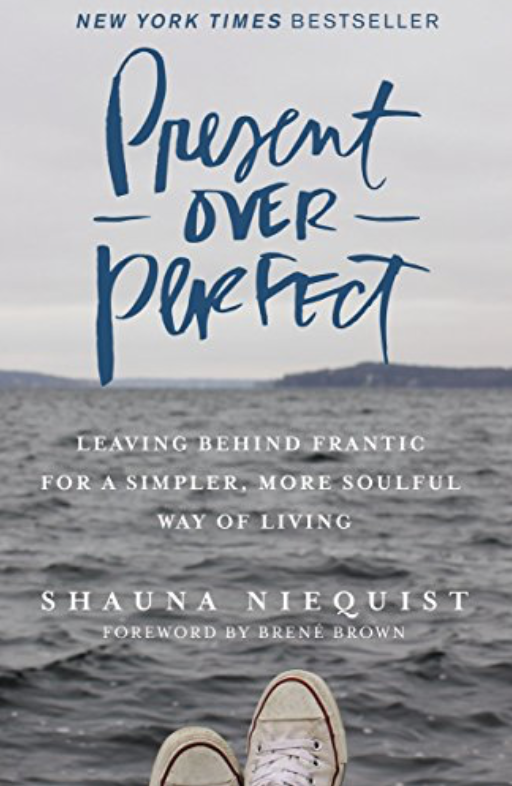
“Perfectionism is an offshoot of fear, one of its most insidious and well-disguised tentacles.
We think perfectionism is really just one tiny shade off from being a hard-worker, being attentive to detail, having high standards. And when we think of it that way, it seems like kind of a good thing, which is why so many of us have allowed it to terrorize us for so many years.
But it’s darker than that: it’s a futile attempt to control what can’t be controlled because we don’t trust that people will see us as good, talented, valuable, and kind if we are not PERFECT.
Perfectionism is the dead opposite of trust—it’s frantically trying to cover all the bases, reply to every possible follow-up question, write air-tight arguments.
That’s a horrible way to write. That’s a horrible way to live.
Years and years ago, someone gave me a piece of writing advice that I still use almost every day, more than a decade into my life as a professional writer. I don’t even know who told me this—I wish I did, because I would send them beautiful flowers or bourbon, my eternal thanks for a trick I’ve been employing near constantly.
And this is it: when you’re stuck, write a letter to someone who loves you.
Whatever you’re writing, pretend that it’s a letter to someone who generally has your back, who wants you to succeed, who thinks you’re great and gives you all the benefits of all the doubts.
Another way to say it: don’t get stuck and tangled and paralyzed imagining all the ways the internet will systematically dissect and destroy every sentence you string together.
The bad news is that they might indeed do that. But you’ll never ever get good writing done if you think too much about that part of it.
So I trick myself, and I write to someone who loves me, the same way you’d pour out your story over coffee to a friend who’s known you forever, fearlessly and without editing every word, without positioning and image-managing and defensive explaining.
Just say what it is you want to say, in the plainest terms, unvarnished and unapologetic.
And so my advice to you: begin with a blank page, and the face of someone who loves you.
There will be enough time for aggressive, incisive, radical editing—I love editing. It’s one of my favorite activities. But the only way for me to fill the blank page is to start with love, a barricade against perfectionism.”
Shauna’s teaches us that the key to overcoming perfectionism is love.
Let’s be honest: We’re all messy people and each of our messes is as unique as a snowflake.
But through the deep love of Christ, ourselves, and others, we can push back the perfectionism and learn to be fully present…
Even with clothes cascading out of the nightstand and three half-empty glasses of water on our nightstand.
I’m grateful for Shauna, her commitment to always grow as a writer, and her exceptional writing style.
If, like Shauna and me, you feel that nudge to write I’d love to help you get started through our FREE 3-part mini-course designed to help you start writing, sustain your writing, and share your writing. To register, click here.


This is freeing and convicting (in a really good way) to be mindful who I raise my kids. My desire is for them to be secure in love and not stuck in fear. Thanks so much for sharing. And I’m thinking Shauna’s book needs to be added to our MOPS reading list!
I am also a perfectionist for now that I’ve read your post from Shauna I realize the reason. My room was a constant mess, but in my mother’s alcoholic stupors, so was the entire house. She was NOT a perfectionist and her expectations for us were very low. I felt a deep sense of shame on the occasions when a friend came to spend the night or a relative saw my room and questioned the mess. I am now a therapist (far surpassing anything I did while my parents were alive…even getting kicked out of high school) and I see perfectionism in so many clients. It’s like they have a bully sitting on their shoulders. I love the writing advice too. I am taking that one to heart! Thanks Shauna, and thanks Margaret for having Shauna guest post. I have read every one of her books and love them all…and her! (And you! I’ve taken your Bible studies. ;o)
Love this! I wear a ring daily that says, “Love conquers everything”, but I’ve never considered perfectionism as part of “everything”. Thank you, from another recovering perfectionist, Margaret for a new perspective!
as a gifted child my parents – especially my father pushed me to do better – no matter what. I was advanced over my year of age into a higher and older class – when I became second in class of older students my father said – now if you try harder you could have been best – no well dones or anything – it broke me and although at college at 13 years of age I could not forget the meaning of his words – you are never good enough – sad
I can so relate Linda! I think that for most of my life it was if ‘I’ was going to make sure that ‘I’ wasn’t going to have the same ‘messed up’ life. I see the perfectionism in my oldest sister and brother too. Perfectionism being the opposite of Trust and Love cures perfectionism. Wow! Made me be reminded that God is Love and perfect Love casts out fear…so who do I trust? The responses from others or a perfect God who uses everything in my life for good? Even that sneer from my sister when she comes over and sees tumble hair balls from my dog and a pile of dishes in the sink, I will love her.
Woo hoo!
Thanks for the encouragement 🙂
So glad you loved her advice 🙂
“And so my advice to you: begin with a blank page, and the face of someone who loves you.” I love this on so many levels! And why not have that be the face of Christ whose unconditional, everlasting, faithful love is just the focus I need as I write each word. Thanks so much for sharing this!