
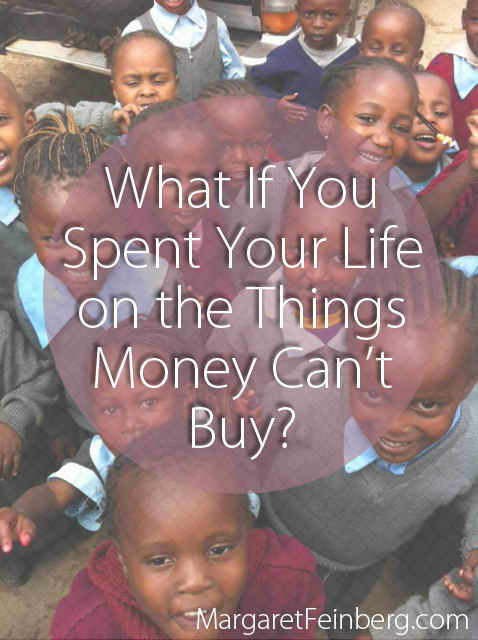
Today Leif and I spent the day in one of the poorest slums in Nairobi, Kenya. We visited a Compassion project committed to providing education and food to those in the most desperate situations. (Click here to learn more).
At one point, I asked our leader, Rich, if everyone in the room could leave—except for the young women.
At first glance, the nearly dozen women look like your average group of teenagers and young twenty-somethings—smartly dressed, giggly, and full of life.
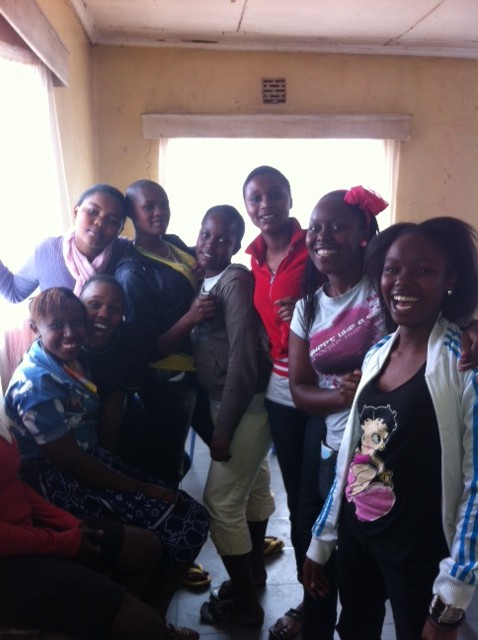
I longed to hear their stories—unedited, unscripted—of what it was like to grow up in a slum.
They were hesitant at first, relying on generalizations and religious clichés, but quickly shifted to honestly sharing from their own lives.
All were born in extreme poverty. The majority were orphans. Many had lost their parents to HIV. When they weren’t at school, they did their best to raise their younger siblings.
“What’s life like in the slum?” I asked.
“Unspeakable things happen,” one woman said.
In addition to the prominence of hardcore drugs, more than half of those who live in the slums resorted to selling alcohol to survive—a dangerous homebrew made from sewer water. Those who sell soon begin drinking. The result is every kind of abuse imaginable and unimaginable.
The women estimated that at least 60 percent of their friends had already been raped. I had a hunch that included some of those in the room, but hesitated to ask.
This is a place where it’s not uncommon to see girls pregnant at the age of 9. But any girl who gets pregnant and doesn’t have an abortion is thrown out of the home and inadvertently shoved into a life of prostitution.
Meanwhile, there’s no running water in the homes. Open sewer lines, often clogged with garbage, run in the middle of the street. The scent of urine, feces, body odor, and trash along with oil from fried potatoes hangs heavy in the stuffy air.

“I’ve come across kids drinking out of the open sewer with straws,” one woman said.
“What do you do when that happens?” I asked.
“Throw away the straws,” she said.
Their descriptions left me speechless.
“Let me ask you this,” I pressed. “If you could convince the Kenyan government to change anything in this slum, what would you have them change?”
My mind spun with possibilities. Close the sewers. Clean up the river. Provide fresh, clean drinking water. Pave the roads. Invest in education. Remove the garbage heaps.
“If I could have them change anything,” one woman said. “I’d have them change the mentality.”
“What do you mean?”
“You can fix the sewers and the trash and clean this place up, but if you don’t change the mentality, nothing will change.”
She was right—and that’s when I understood the difference Compassion was making among the poorest of the poor in this neighborhood. Sure, there’s food and education, but what they’re really giving is so much more.
The Compassion project teaches kids about nutrition, sanitation, and health. They’re helping them develop social skills as well as lasting friendships with others who are making healthy decisions for their lives.
They’re providing role models of those who have grown up in the same community, the same conditions, but are choosing to break the cycle of poverty and live different. Each day the kids get a vision for a new normal, a new way of life. And it’s not just for the individual kids within the families. They go home and share what they’ve learned with their parents and siblings. They’re introducing them to Jesus. They’re getting them plugged into the local church.
In a word, they’re giving them HOPE. [Tweet this]
Maybe that’s one reason those lucky enough to be in the project are referred to being in the “Valley of Hope.”
As we packed up to leave, I was struck by an image of the kids on the outside of the gate.
They stood, gripping the metal bars, longing to be accepted into the program. 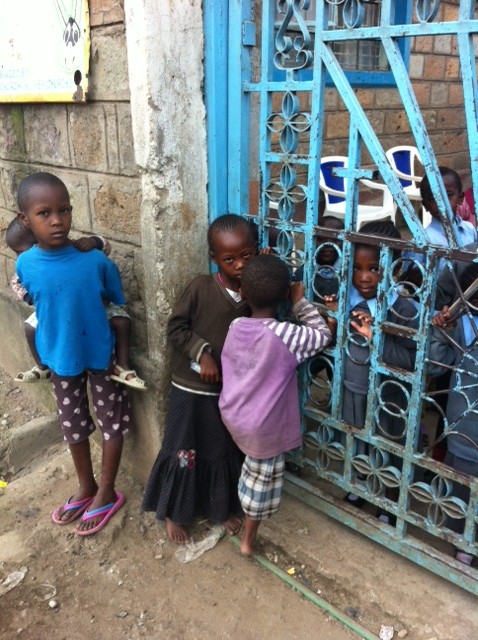
But adding more kids to the program requires sponsors. People like you and me who will open the gate for them and say “yes” to a whole new life of possibilities, one marked by hope.
You and I can open the gate for more kids—not just in Kenya but around the world—for just $38 a month.
Will you join me and sponsor a kid today? Click here to open the gate to kids waiting for a sponsor. [Tweet this]


I enjoy your posts.
I’m in tears. Thank you for this beautiful post and for giving us a glimpse into your first day and into the lives of those young girls. Heartbreaking…thankful we all have an opportunity to be a solution one child at a time.
Thank you, Margaret!
Kirsten, I am so thrilled this moved you!
Be blessed for your love and compassion and indeed the kind actions. God is with you and will continue to guide you in your fruitful ministry. I’m Kenyan and I’m encouraged in reading this.
Margaret, I read of the things that happen, both spoken of and unspoken – only hinted at – and I am moved with a longing to help more than the 2 children we sponsor each month. What else can those of us who simple cannot travel away at this season of life, do? I so want to wrap each on of those teenage girls up and just smother them with “things”. And yet, they speak of the “mentality” as being what’s important. Hope, indeed! Thank you for you and your husband’s servant heart. I look forward to reading as you continue on there.
So wish to expand havens like Mercy House for the girls there.
Thank you for writing about Compassion. We have been so blessed by the relationships there.
Newton, I am so thrilled this resonated with you!
Missy, I am so glad this stirred in your heart! Praying that God continues to allow you to be sensitive to the needs of those that need Hope.
Tricia, so glad it resonates with you!
789alo: 789alo – 789alo
mexican pharmacy online store mexican pharmacy online store reliable mexican pharmacies
reliable mexican pharmacies: mexican drug stores online – mexican drug stores online
https://mexicanpharminter.shop/# mexican pharmacy online store
adderall canadian pharmacy
http://mexicanpharminter.com/# mexican pharmacy online store
india online pharmacy store: india pharmacy without prescription – order medicines online india
online medicine shopping in india: lowest prescription prices online india – online medicine shopping in india
safe online pharmacies in canada certified canada pharmacy online canadian online drugs
https://mexicanpharminter.com/# buying from online mexican pharmacy
Mexican Pharm International: mexican pharmacy online – mexican pharmacy online
canadian online pharmacy reviews: Certified International Pharmacy Online – ed drugs online from canada
buying from online mexican pharmacy Mexican Pharm International Mexican Pharm International
https://indiamedfast.com/# india pharmacy without prescription
canadian pharmacy
canadian pharmacy online ship to usa: certified canada pharmacy online – canada pharmacy world
http://interpharmonline.com/# legitimate canadian pharmacies
mexican pharmacy online: reliable mexican pharmacies – reliable mexican pharmacies
http://interpharmonline.com/# canadian pharmacy drugs online
canada pharmacy online legit
legitimate canadian pharmacies Online pharmacy USA ed meds online canada
https://interpharmonline.shop/# the canadian drugstore
canadian pharmacy checker: canada pharmacy no prescription – canada pharmacy online
https://indiamedfast.shop/# IndiaMedFast
canadian pharmacy oxycodone
recommended canadian pharmacies: most reliable canadian online pharmacies – legitimate canadian pharmacy
https://mexicanpharminter.shop/# buying from online mexican pharmacy
reliable mexican pharmacies buying from online mexican pharmacy mexican pharmacy online order
https://indiamedfast.shop/# IndiaMedFast
canadian pharmacy sarasota
cheapest online pharmacy india: order medicines online india – online medicine shopping in india
reputable canadian pharmacy: InterPharmOnline.com – canadian drug
http://tadalafileasybuy.com/# cialis without a doctor prescription
http://tadalafileasybuy.com/# cialis without a doctor prescription
Cialis without a doctor prescription: Tadalafil Easy Buy – Tadalafil Easy Buy
kamagra 100mg kopen: KamagraKopen.pro – kamagra gel kopen
kamagra 100mg kopen KamagraKopen.pro Kamagra Kopen Online
https://kamagrakopen.pro/# Kamagra
TadalafilEasyBuy.com: cialis without a doctor prescription – cialis without a doctor prescription
KamagraKopen.pro: Officiele Kamagra van Nederland – Officiele Kamagra van Nederland
https://kamagrakopen.pro/# kamagra kopen nederland
cialis without a doctor prescription TadalafilEasyBuy.com cialis without a doctor prescription
http://generic100mgeasy.com/# Buy generic 100mg Viagra online
Kamagra: Officiele Kamagra van Nederland – KamagraKopen.pro
kamagra pillen kopen: kamagra jelly kopen – Kamagra Kopen Online
Generic 100mg Easy: buy generic 100mg viagra online – Generic100mgEasy
https://generic100mgeasy.shop/# Cheap generic Viagra online
kamagra jelly kopen: kamagra jelly kopen – kamagra kopen nederland
Buy generic 100mg Viagra online Cheap Viagra 100mg Sildenafil Citrate Tablets 100mg
Generic Cialis price: Cialis 20mg price in USA – Tadalafil Easy Buy
Generic100mgEasy: Generic100mgEasy – Cheap generic Viagra online
http://generic100mgeasy.com/# sildenafil online
kamagra kopen nederland: kamagra pillen kopen – kamagra jelly kopen
kamagra pillen kopen Kamagra kamagra 100mg kopen
http://generic100mgeasy.com/# Generic100mgEasy
kamagra gel kopen: Kamagra – kamagra kopen nederland
https://tadalafileasybuy.shop/# cialis without a doctor prescription
http://generic100mgeasy.com/# Generic 100mg Easy
TadalafilEasyBuy.com: cialis without a doctor prescription – TadalafilEasyBuy.com
Tadalafil Easy Buy: Buy Tadalafil 5mg – cialis without a doctor prescription
https://tadalafileasybuy.com/# TadalafilEasyBuy.com
buy generic 100mg viagra online sildenafil 50 mg price Generic 100mg Easy
KamagraKopen.pro: kamagra jelly kopen – Kamagra Kopen